Wanted: Canadians. How Hollywood Keeps Raiding Our Talent Pool — and What We're Doing About It

There's a running joke in the Canadian entertainment industry: the best way to become famous in Canada is to leave it. Schitt's Creek broke the internet, Simu Liu became an Avenger, and Elliot Page is redefining what it means to be a leading person in Hollywood. But behind every marquee name is a quieter, more systematic story — one about casting directors with Toronto area codes on their phones, agents flying into Vancouver for weeklong talent sweeps, and streaming giants quietly building recruitment pipelines that stretch from St. John's to Surrey.
Hollywood isn't stumbling across Canadian talent by accident anymore. It's hunting for it.
The Recruitment Machine Nobody's Talking About
If you work in the industry, you already know. Casting notices for major U.S. productions — Netflix originals, Apple TV+ prestige dramas, even big-budget theatrical releases — are increasingly being distributed through Canadian talent agencies and drama schools. The Actors Studio in Montreal, the National Theatre School, Vancouver Film School: these institutions are now on the radar of international casting directors the way Juilliard and NYU have been for decades.
"It used to feel like a happy accident when one of our clients got called in for something major," says one Toronto-based talent agent who asked not to be named because of active relationships with U.S. studios. "Now we're getting outreach on a semi-regular basis. They're not waiting for us to submit anymore. They're asking us who we have."
Part of what's driving this is practical: Canada's deep pool of trained, versatile performers who work for comparatively less, combined with co-production treaties that offer financial incentives to studios willing to cast domestically. But agents and casting professionals will tell you it goes beyond the economics. There's a specific quality to Canadian-trained talent — a groundedness, a lack of ego, a technical precision — that productions are actively seeking out.
The Actors in the Middle of It All
For the talent themselves, the experience is more complicated than a simple success story.
Take the trajectory of someone like a mid-career actor based in Hamilton, Ontario — the kind of person who's spent a decade building credits on CBC dramas and Crave originals, earning genuine respect within the Canadian industry, only to get a call from a Los Angeles-based casting director who saw a self-tape submission and wants to fly them in for a streaming series pilot. It's the call every Canadian actor has fantasized about. It's also the beginning of a very difficult conversation about identity, loyalty, and what success is actually supposed to look like.
"There's this weird guilt," one Canadian actor who recently relocated to Los Angeles for a recurring role on a major streaming drama told us. "You feel like you're abandoning something. Like you worked so hard to be part of building something real here, and then you leave just when it's getting good. But also — you go where the work is. That's always been true."
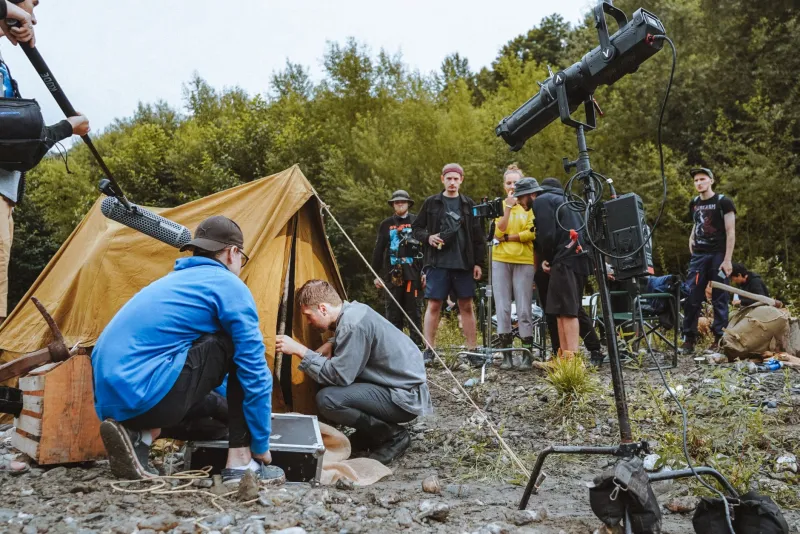
That tension isn't unique to actors. Canadian writers are being recruited into writers' rooms for prestige American television at an increasing rate. Directors who've cut their teeth on TIFF selections are getting calls from studios. Below-the-line crew — the cinematographers, production designers, and sound mixers who make up the invisible backbone of any production — are in particularly high demand, with skilled Canadian technicians being offered contracts that would take years to match domestically.
What Gets Left Behind
Here's the part that doesn't make it into the feel-good headlines: every time a Canadian creative gets absorbed into an international production, the domestic ecosystem loses something it can't easily replace.
Canada's homegrown content sector has spent the better part of two decades building infrastructure — funding bodies, broadcaster relationships, festival circuits, training programmes — designed to develop and retain creative talent. The Canada Media Fund exists precisely because the industry recognised that without structural support, the gravitational pull of larger markets would hollow out domestic production. And it has worked, to a meaningful degree. Canadian television has never been more ambitious, more diverse, or more internationally competitive than it is right now.
But ambition and infrastructure can only do so much when the person you just spent five years developing gets a call from a streamer with a budget that dwarfs the entire annual output of a mid-sized Canadian production company.
"We're essentially subsidising the training of talent for international markets," says one veteran Canadian producer with credits spanning film and television. "Which isn't entirely a bad thing — it raises our profile, it creates relationships, it puts Canadian names on projects that get seen globally. But we also need those people here, telling our stories, building our industry from the inside."
The Case for Staying — and What Makes It Compelling
Not everyone is packing their bags, and some of the most interesting voices in Canadian entertainment are making a deliberate choice to stay rooted.
The argument for building a career within Canada has gotten genuinely stronger over the past few years. Streaming platforms have increased their Canadian original content commitments. BIPOC creators are finding funding pathways that didn't exist a decade ago. And there's a growing sense — particularly among younger creators — that telling Canadian stories, set in Canadian places, for Canadian audiences, is its own form of creative ambition rather than a consolation prize.
"I think the narrative that you have to leave to matter is getting challenged," says one Montreal-based filmmaker whose recent feature played at multiple international festivals without a single American co-production partner. "There are people doing genuinely world-class work here, on their own terms. That's not nothing."
Casting directors working domestically echo this. The talent pool isn't draining entirely — it's diversifying. As some established names get pulled toward international productions, space opens up for emerging voices who might otherwise have spent years waiting in line.
The Bigger Picture
What Hollywood's sustained interest in Canadian talent ultimately reveals is something the industry here has always known but rarely said out loud: we are exceptionally good at this. The training is rigorous, the work ethic is real, and there's something in the cultural DNA of Canadian storytelling — an instinct for nuance, for complexity, for stories that resist easy resolution — that translates across borders.
The question isn't whether Canadian talent deserves international recognition. Obviously it does. The question is whether the structures we've built at home are strong enough, generous enough, and ambitious enough to give our best creatives a reason to stay — or at least to come back.
Because the most exciting version of Canadian entertainment isn't the one where our people go make someone else's stories bigger. It's the one where they stay, or return, and make ours impossible to ignore.
And honestly? We're closer to that than we've ever been.